
- Eyebrow tag: For multi-metro operators · 50+ locations
Beyond self-serve. Workforce mobility infrastructure for multi-metro operators.
- Self-serve vs Enterprise
Two ways to use SwitcherHub. You choose the path that fits your size.
SwitcherHub (Self-serve) | SwitcherHub Enterprise | |
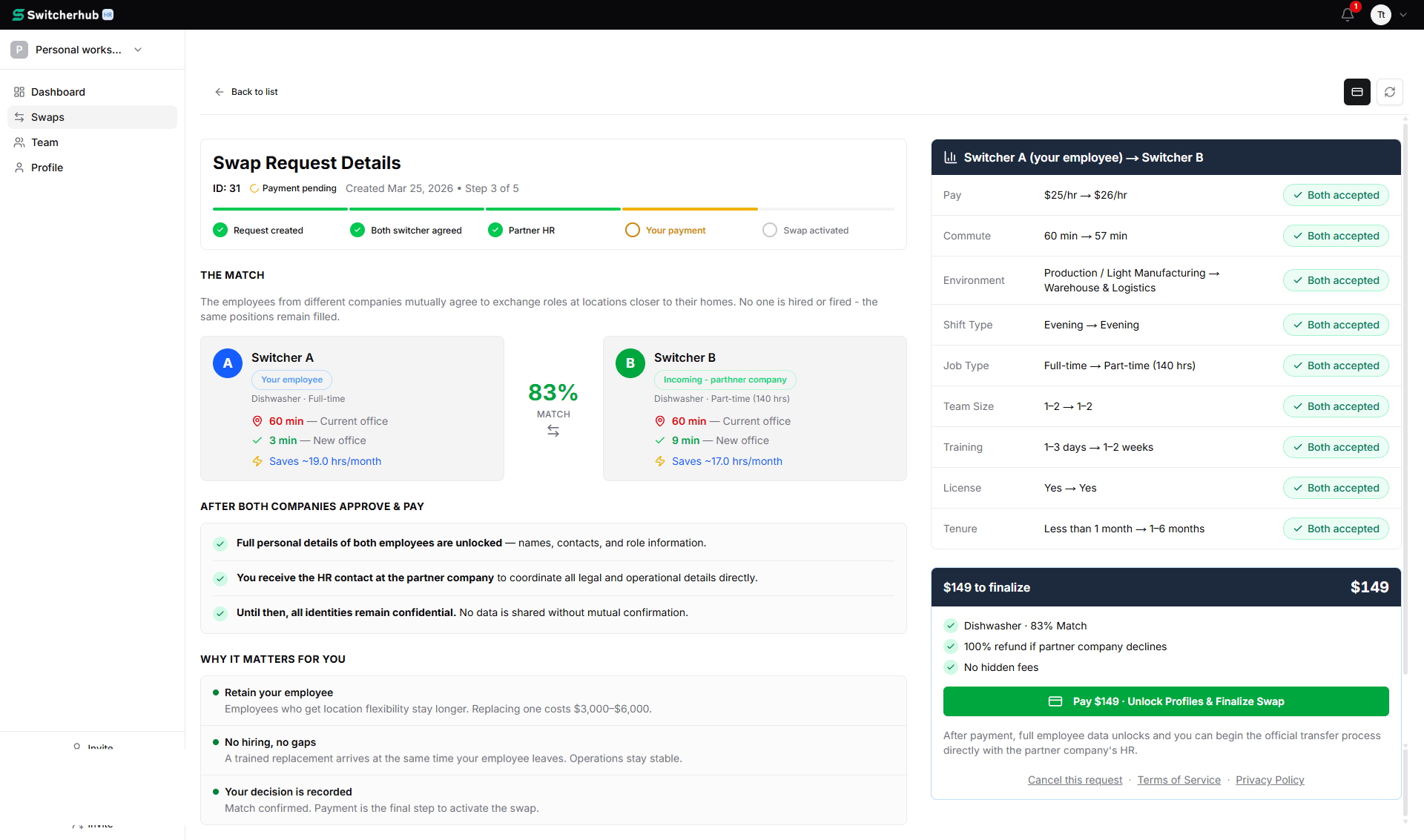
Pricing | $150 per swap | Custom annual contract |
Setup | 5 minutes, sign up online | 4–6 weeks integration project |
Contract | None | Annual MSA (12-month minimum) |
Support | Email, standard response | Named CSM, signed SLA |
Integration | Manual roster, link-based | HRIS sync (Workday, ADP, others) |
Reporting | Basic dashboard | Workforce analytics, board-ready |
Best for | 1–50 locations, ad-hoc swaps | 50+ locations, programmatic mobility |
You don’t need to wait for an enterprise contract to start. Most chains begin with the self-serve product, validate the model in a few locations, and graduate to Enterprise when their volume or procurement requirements call for it.
- How It Works
Why pay-per-swap stops working at scale
Procurement won't sign transactional vendors
Corporate finance requires annual contracts with predictable spend, not pay-per-event invoices. Your CFO needs a number for the budget. Not a range.
Per-swap pricing breaks expense approval workflows
Every transactional charge has to flow through approval chains. At 30+ swaps per month, this becomes administrative overhead that kills adoption. Your HR managers stop using a product they have to justify line-by-line.
Without integration, data lives in a separate system
Roster sync, location codes, role taxonomy — all maintained manually. Across 100+ locations, that’s not a workable model. Enterprise needs the data flowing in and out of systems your team already uses.
- Pricing
What's inside the platform contract
HRIS & payroll integration
Included: One-way data sync with Workday, ADP, Paychex, BambooHR, and UKG. Optional write-back for swap approvals.
What it delivers: Roster updates automatically. No manual data entry. Swap approvals trigger downstream payroll changes without HR intervention.
Implementation: Dedicated integration project, 4–6 weeks scoped during discovery.
Service Level Agreement (SLA)
Included: 99.9% uptime guarantee, 4-hour ticket response time, match-quality threshold, monthly accuracy reporting. Service credits if SLA is breached.
What it delivers: Procurement signs the contract without escalation. Legal team checks the box. Operations team has measurable accountability.
Format: Signed addendum to master service agreement.
Dedicated customer success
Included: Named CSM, priority ticket queue, monthly check-in calls, quarterly business reviews with measured ROI reporting.
What it delivers: HR leadership sees cost-of-turnover-saved in dollars every quarter. Your CSM becomes an internal advocate inside our organization.
Not included: 24/7 phone support, on-site visits — available as separate premium add-ons.
Workforce analytics dashboard
Included: Aggregated retention metrics across all locations, location-level turnover trend reports, predictive churn signals, anonymized industry benchmarking.
What it delivers: VP HR gets board-ready reports without data team intervention. Regional managers see which locations are in the risk zone before turnover happens.
Strategic value: Most enterprise HR teams already pay for workforce analytics from PayScale, Mercer, or industry consultants. Our data is real-time and behavior-based — not survey-based.
- · Pricing
Transparent enterprise pricing. Custom-scoped to your operation.
Platform fee | Monthly subscription based on location count and complexity |
Included swap volume | Negotiated based on historical turnover patterns |
Overage rate | Materially below standard pay-per-swap pricing |
Annual contract | 12-month minimum · multi-year discount available |
Setup & integration | One-time fee, scoped during discovery |
Typical annual contract value: $40,000–$80,000
- Security & compliance
Built for enterprise procurement review.
Available today:
- Encrypted data in transit and at rest
- Role-based access controls
- Audit logging for all platform actions
- Secure authentication
On our enterprise roadmap:
- SOC 2 Type II audit
- Single sign-on (Okta, Azure AD, Google Workspace)
- Advanced data residency options
- BAA availability for HIPAA-adjacent verticals
- How enterprise onboarding works
From first call to full rollout — what to expect.
Discovery (week 1–2)
Founder call, technical evaluation call with your IT team, scoping document covering integration surface and SLA requirements.
Contract & integration (week 3–8)
Master service agreement signed. Integration project kickoff with your HRIS team. Sandbox environment provisioned for testing.
Pilot (week 9–16)
Rollout (month 5+)
- Frequently asked questions
The questions enterprise procurement, IT, and legal teams ask first.
No. SwitcherHub is a workforce mobility intelligence platform. Workers remain employed by their respective companies before and after a swap — we facilitate the match, employers make every employment decision. We do not assume joint employer status, payroll responsibility, or W-2 obligations.
Defined data retention and deletion policy in the master service agreement. Default: worker data tied to your organization is deleted within 30 days of contract termination, subject to legal hold requirements. Aggregated, anonymized analytics may be retained for benchmarking purposes only.
Workers self-select swap interest by opting into the platform. Employers approve or decline each swap based on the same criteria they would use for any internal transfer. SwitcherHub does not make hiring decisions — we surface mutual matches, employers act on them. This keeps you outside the algorithmic-decision compliance surface.
Not in current product. White-label is on our roadmap for Year 2 and is custom-scoped per enterprise contract. We can discuss interim co-branding options during discovery.
Available now: link-based HR portal access, manual roster CSV upload, Stripe billing. In active development: Workday and ADP read-sync. On roadmap: Paychex, BambooHR, UKG, write-back for swap approvals. We sequence integration build based on signed enterprise customer requirements.
Multi-brand operators are scoped during discovery. Typical structure: one master agreement covering all brands, with brand-level location grouping in the platform. Cross-brand swaps within your portfolio are supported and often a high-value use case.
Enterprise contracts start with a founder conversation.
No demo decks. No salesperson. A direct call with the CEO to understand your operation, your turnover patterns, and whether SwitcherHub Enterprise fits.